
Why is everyone talking about ComfyUI in 2026?
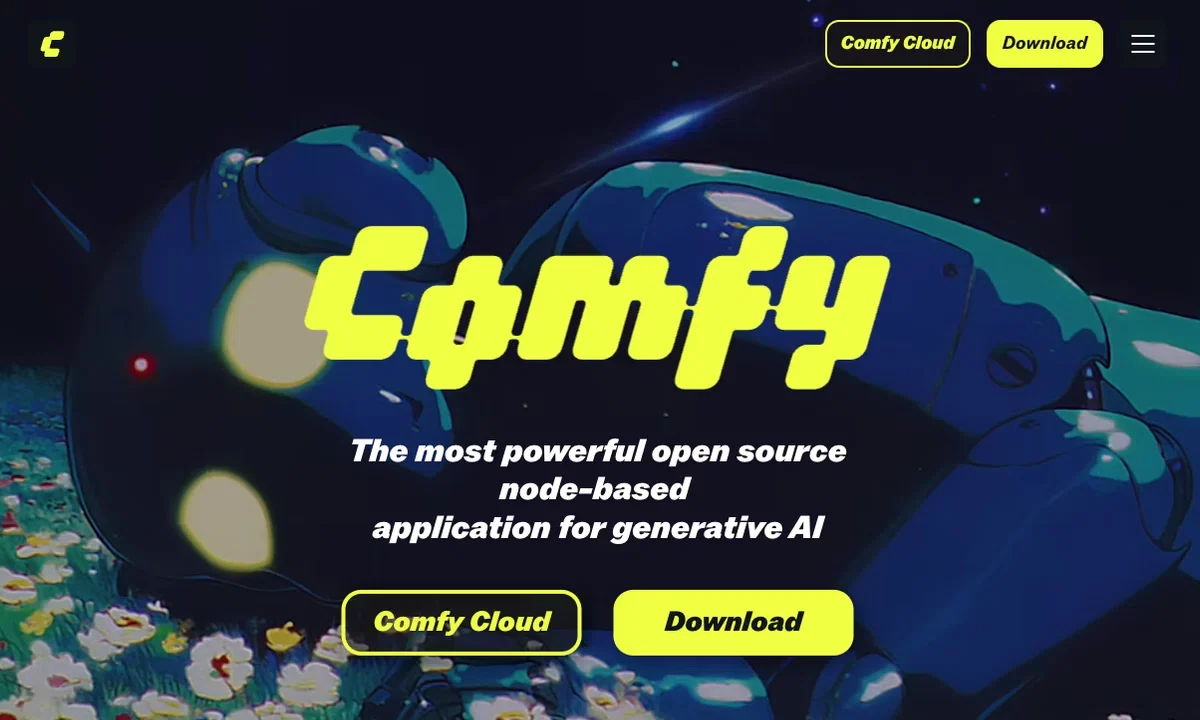
Why ComfyUI is at the centre of creative AI in 2026
In just a few years, ComfyUI has gone from a simple open-source project to a genuine de facto standard for building AI workflows for images, video, 3D and even audio. With more than 4 million users, tens of thousands of community nodes and massive adoption by studios, the tool has become a "production engine" for creators who want to keep full control over their pipelines.
In 2026, momentum is building even faster: a funding round, new 3D integrations, support for cutting-edge models and a big push on stability. If you already work with Stable Diffusion, generative video or 3D, or if you're looking to industrialise your creative workflows, ComfyUI is hard to ignore.
Several major announcements redefine ComfyUI's position
1. A $30M round to accelerate the ecosystem
In late April 2026, ComfyUI announced a $30 million funding round, valuing the company at $500 million and bringing total funding to $48 million. The round is backed by impressive growth: more than 4 million users, 60,000+ community-built nodes and more than 150,000 downloads a day.
The stated goal: strengthen the open-source infrastructure, develop the cloud offering (Comfy Hub) and speed up the integration of new models (image, video, 3D, audio) into the same workflow environment.
2. A strategic partnership with Tencent Cloud for 3D
In late March 2026, Tencent Cloud announced a partnership with ComfyUI to integrate its Hunyuan 3D model (HY 3D Global) as a native "Partner Node". In practice, creators can call advanced 3D generation capabilities directly in their ComfyUI graphs, without leaving their usual pipeline.
ComfyUI is thus positioned as a unified platform for image, video and 3D, adopted by players such as Netflix, Tencent and Ubisoft for their internal workflows.
3. An April packed with new releases
In its April Wrapped post, the ComfyUI team sums up an especially busy April 2026. Highlights include:
- New partner models, such as ByteDance's next-generation video model, integrated as a partner node from day one.
- Native support for Meta's SAM 3 and SAM 3.1 models for image and video segmentation, very useful for rotoscoping, object selection and advanced editing workflows.
- The ability to run several workflows in parallel, a major gain for batching, creative A/B testing or multi-task production pipelines.
The post also highlights the expansion of Comfy Hub, the cloud and content hub layer that centralises models, workflows and shared resources.
Key new technical capabilities in 2026
Beyond the corporate announcements, several recent technical developments concretely change how ComfyUI is used day to day.
Parallel workflows and large-scale production
The new ability to run several workflows in parallel is probably the most important for studios and independents who want to scale. Where you used to queue generations one after another, you can now:
- Run variants of the same concept in parallel (prompt A/B, different styles, sampler settings).
- Dedicate some graphs to pre-production (visual research) and others to final rendering, all at the same time.
- Use ComfyUI as a small personal AI render farm, especially on well-specced NVIDIA RTX machines.
NVIDIA is also promoting ComfyUI as a core building block of its "GenAI Creator Toolkit", with ready-to-use workflows for design and visualisation, optimised for RTX GPUs.
Deep integration with NVIDIA RTX
A recent NVIDIA article details how to build, run and scale high-quality creator workflows in ComfyUI, relying on turnkey production pipelines. The focus is on:
- Running locally: data never leaves the machine, which reassures studios and clients.
- Chaining image generation, video synthesis and language models in a single graph.
- Examples of advanced retouching workflows (inpainting, targeted editing) through a simple node interface.
For a motion designer or VFX producer, this means ComfyUI can become an integrated building block in an existing pipeline (Nuke, After Effects, Resolve), upstream or downstream, for anything involving AI generation and transformation.
An explosion of video and 3D nodes
The April recap and official announcements point to an acceleration of video- and 3D-oriented nodes. Notably:
- Nodes that make it easier to prepare video sequences for AI editing (such as ComfyUI-Wan-VACE-Prep, for video pre-processing).
- New node sets to simplify and stabilise complex video pipelines.
- The arrival of Hunyuan 3D 3.0 and other 3D models via Partner Nodes, opening the door to integrated 3D generation and refinement workflows.
Conclusion: a bridge between VFX and AI
In 2026, ComfyUI is establishing itself as the real bridge between traditional VFX workflows and generative AI inside studios. Where classic pipelines (Nuke, Houdini, After Effects, Blender) stayed siloed, ComfyUI is becoming the meeting point where VFX artists, compositors and AI creatives work on common ground.
With these developments, ComfyUI is no longer just a model front end: it is establishing itself as a true "OS" for AI creation, able to fit into demanding production chains. Several uses clearly stand out, whether you're a freelancer or a studio:
- Creative R&D lab: quickly test new models, combine image, video, 3D and audio in the same graph, and document your best workflows to replay them tomorrow.
- AI production engine: industrialise recurring tasks such as generating shots, spinning out concepts, preparing sequences for editing or creating visual packs for a campaign.
- Bridge to the VFX pipeline: inject AI passes (matte painting, relighting, texture generation, set extensions, previs) directly into existing compositing workflows, without breaking the production chain.
- Shared infrastructure: thanks to Comfy Hub and Partner Nodes, distribute ready-to-use workflows within a team or studio, while keeping a common, reproducible technical foundation.
Put simply: ComfyUI is no longer an isolated geek tool; it's now a strategic link between AI creation and VFX studios.